
What is mobile ad fraud?
Mobile ad fraud is a form of advertising fraud that generates fake traffic, including fraudulent impressions, clicks, installs, or post-install events, with the goal of stealing ad spend or manipulating attribution. Fraudsters operate within publishers, ad networks, ad platforms, or independently. Their actions make it difficult for you to understand the impact of your advertising efforts and allocate ad spend effectively.
Financial gain is a key driver of mobile ad fraud, and low-cost digital tools and fraud-as-a-service platforms have lowered barriers to entry. Anyone with access to cheap smartphones, virtual machines, device spoofing software, or IP masking tools can launch a fraud operation. Guides and tool kits circulate freely online, and fraudsters can easily find low-cost bots. In 2024, Kaspersky found ready-made botnets advertised for as little as $99 and botnet rentals starting at $30 per month.
Mobile ad fraud is a growing problem, as we found in our recent survey of marketing executives:
- Marketing leaders estimate that 27% of paid digital ad spend is lost to fraud annually.
- The average respondent estimates losses of $3 million per year. The largest ad spenders reported losing $9 million or more per year.
- Eighty-seven percent of marketing leaders say concern about ad fraud has increased in the past 12 months.
- A recent report by Juniper Research revealed that advertisers lost 22% of their digital spend to fraud in 2023, or about $84 billion. By 2028, Juniper projects this figure to exceed $170–172 billion.
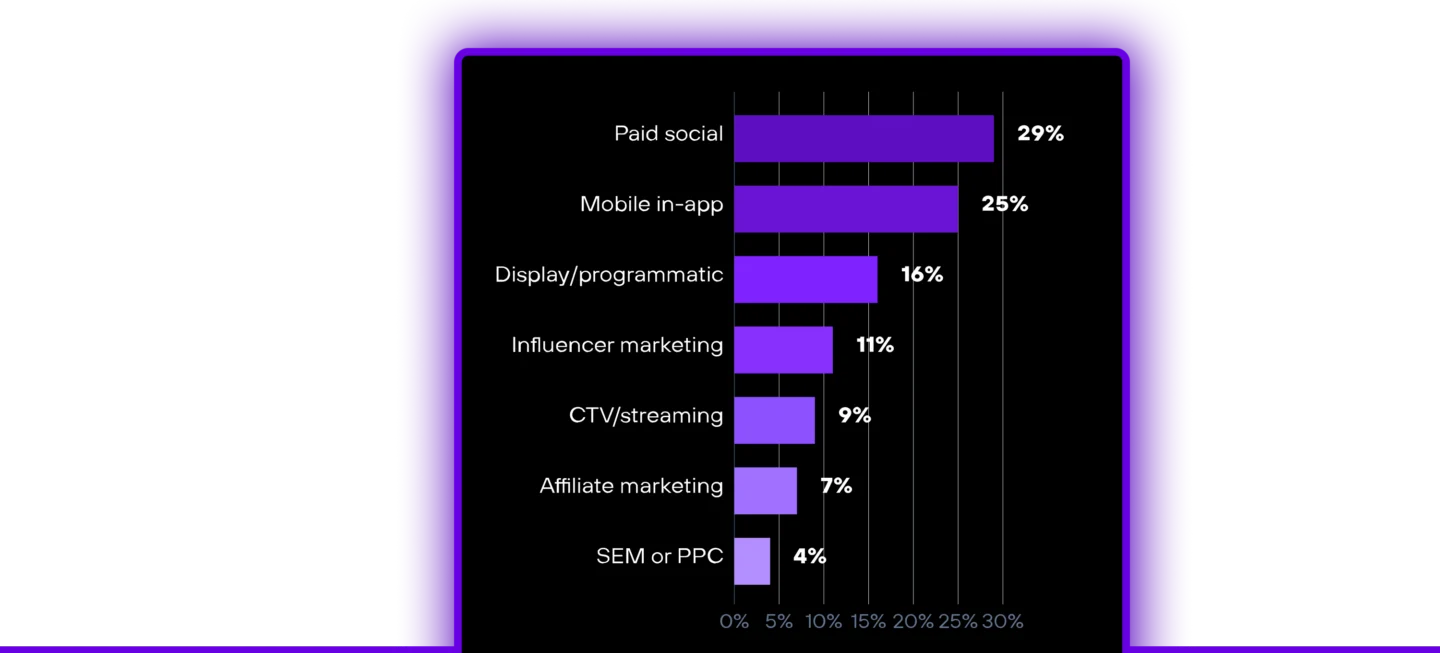
The extent of the problem varies by ad channel. According to those survey respondents, paid social is the channel most vulnerable to ad fraud.
How does ad fraud work?
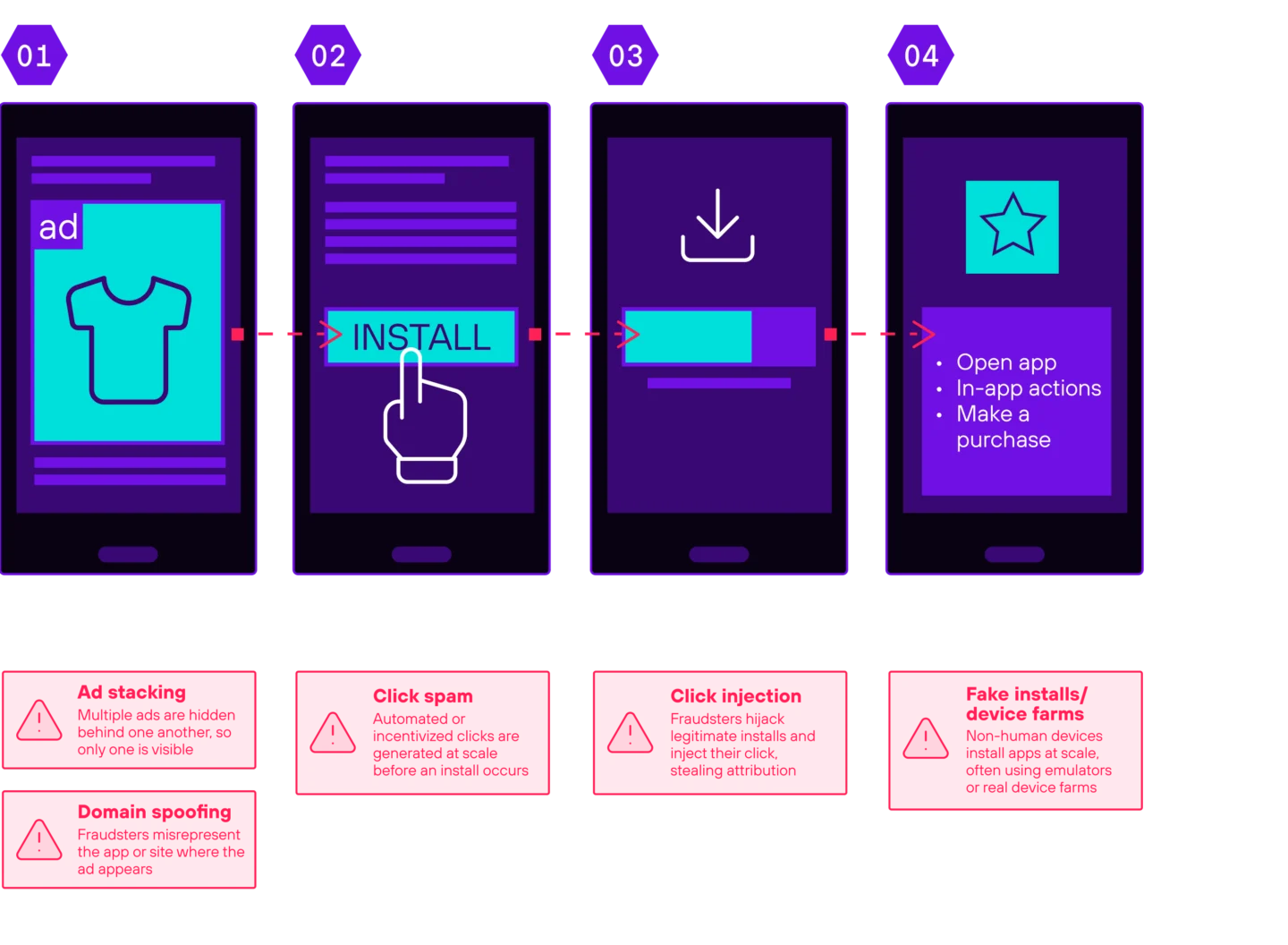
Mobile ad fraud schemes exploit the fragmented nature of the mobile ad ecosystem and the trust of the participants to covertly intervene in the various processes that happen along the customer journey:
- At impression delivery
- When a user views the ad
- During app install
- While users engage with the app
Some of these processes happen on the mobile web and others in the app. Some deceptions co-opt the actions of real users, while others fabricate devices, users, and user actions. Fraud is successful when you can’t tell which impressions, clicks, and installs come from real users and which are fake, and you pay for all of them.
Here’s a simple end-to-end example of how this hits your budget. A user sees and clicks a paid social ad from Network A, but does not install right away. Two hours later, Partner B hits the same device with a fraudulent click through a non-SAN source that is stuffing clicks into the attribution window. The user then installs the app organically after searching the brand name in the app store. Your attribution platform sees Partner B’s click as the last eligible touch and credits the install there. Partner B submits the install for payout. In reporting, Partner B now shows one more attributed install and a lower cost per install (CPI) than it earned; organic is undercounted, and Network A loses credit for the assist that actually introduced the user. If that user makes a purchase on day three, revenue can get tied back to Partner B as well, making its return on advertising spend (ROAS) look efficient.
Your weekly dashboard now tells the wrong story because paid acquisition appears stronger, organic looks weaker, and the team risks moving budget toward a source that did not create real value.
Common types of mobile ad fraud
As the mobile ad ecosystem develops, fraudsters are using increasingly sophisticated techniques to mimic human activity, including AI agents, bots, and automated virtual servers. Here are the most prevalent types of fraud you should be aware of:
- Click spam / click flooding. In this type of attribution theft, fraudsters generate millions of fake clicks using random device IDs and then attribute later real installs to the fake clicks.
- Click injection / click hijacking. Malware detects a mobile app install in progress and fires a click immediately before completion to claim last-click attribution credit.
- Ad stacking. This type of impression fraud includes hidden ads, stacked ads, and invisible placements, all of which generate income, even though no human ever views the ads.
- Domain spoofing. Fraudsters trick advertisers into paying for ads displayed on sites other than the intended ones. The other sites typically incur higher costs.
- Fake installs through device farms, emulators, and software development kit (SDK) spoofing. Device farms use emulators and virtual machines to create thousands of fake devices that seem to “install” apps. Fake installs neither serve real users nor contribute to lifetime value.
How to detect mobile ad fraud
Your path to stopping fraudulent activity starts with detecting the fraudsters’ deceptive signals, including click-to-install patterns, device and behavioral data, and invalid traffic.
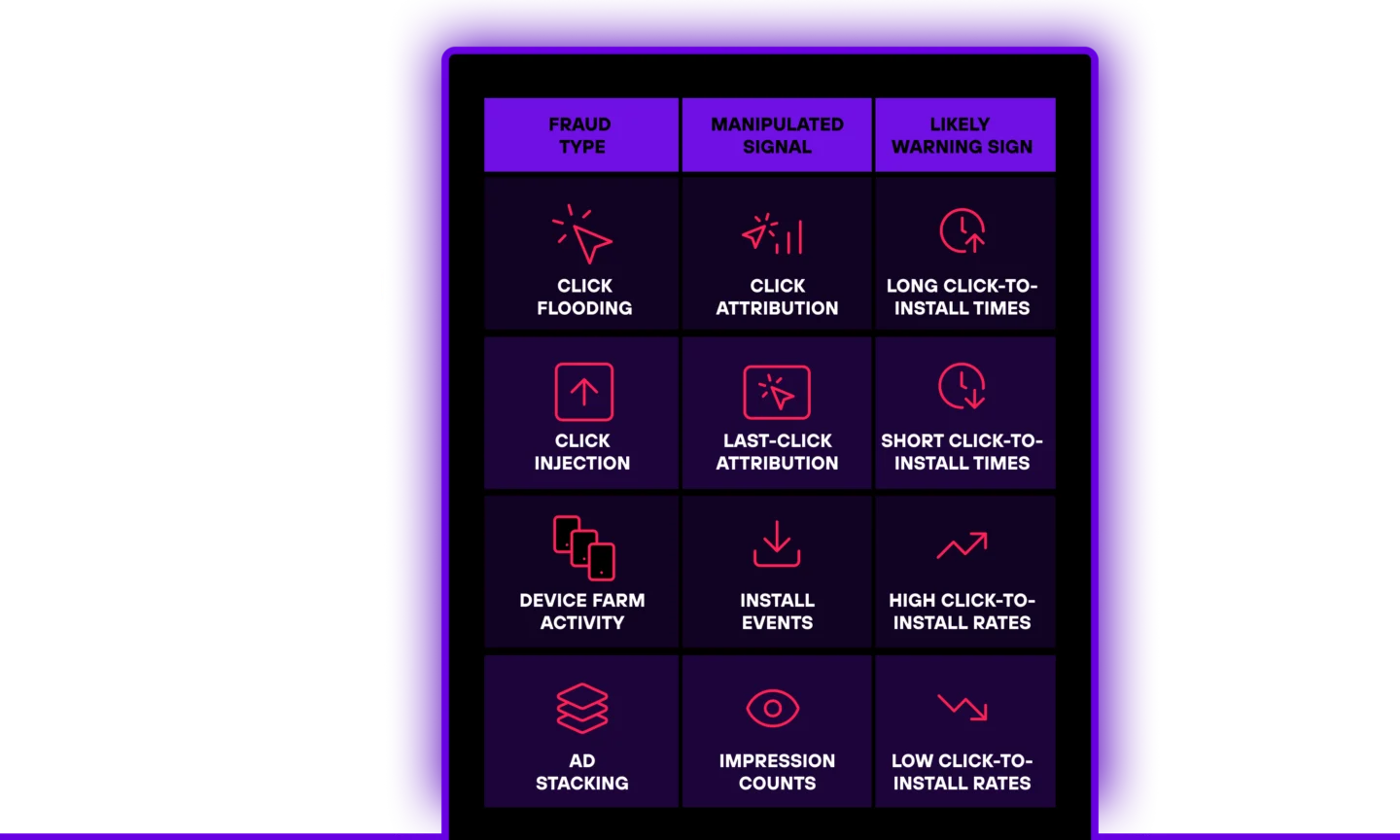
Click-to-install anomalies. The frequency and speed of installs can be your first clue, especially for click flooding, click injection, device farm activity, and ad stacking.
- Long click-to-install times indicate click flooding. When a real user clicks to install an app, the install happens right after the click. Click flooding produces clicks that aren’t connected to the actual install, so they rarely occur immediately before it.
- Short click-to-install times signal click injections. Malware triggers fake clicks after the app install begins, instead of a few seconds before, as would normally occur.
- When the click-to-install rate is far beyond what you might expect for human users, even for a highly successful ad, you can suspect device farm activity.
- Low click-to-install rates are a sign of ad stacking because ad targets aren’t seeing all those ads, just the one on top.
Device and behavioral signal mismatches. Despite their increasing sophistication, bots and fake devices display behaviors that don’t align with normal human actions:
- Retention. Fraudulent users churn quickly, device farms don’t reengage, and bots don’t come back once their scripted flow ends. Be concerned if you see nearly 100% Day 1 drop-offs, identical retention patterns across networks, uniform session times, and no meaningful engagement after install.
- Post-install abnormalities. Look for signs like onboarding flows completed too quickly or too perfectly, conversions that occur without realistic session context, and multiple “users” sharing identical event timestamps.
- Unusual geographic and device clusters. Common red flags include a high percentage of installs from a region you’re not targeting, unusually high install rates from outdated OS versions, and repeated IP ranges or data centers.
- Last-touch attribution overperformance. Click spammers and injectors generate a flood of last-moment interactions milliseconds before an install begins or across campaigns where you historically don’t see click behavior.
Branch’s 2026 ad fraud report shows that 77% of marketers use a dedicated tool to detect mobile ad fraud. Leading tools offer:
- Real-time statistical anomaly detection augments static rules to help find fraudulent traffic patterns as they appear. Then the tool can apply invalid traffic filtering to block them.
- Machine learning-based adaptive algorithms that evolve as fraud patterns change keep pace with AI-assisted fraud practices.
- Automated detection across large datasets enables you to scale fraud protection along with your operations.
The full cost of mobile ad fraud
More than a simple act of theft, pervasive mobile ad fraud distorts signals and hampers business activity throughout the mobile ad ecosystem. Impacts include:
- Wasted spend. It misdirects precious ad spend toward audiences and placements that will never generate revenue.
- Ineffective decision making. When you can’t see the true impact of your ad placements and channels, you can’t properly allocate budgets going forward.
- Damaged partner trust. Mobile ad fraud requires increased scrutiny of publishers, ad networks, and traffic sources.
How to prevent mobile ad fraud
Catching fraud after the fact means the money’s already gone. And manual review can’t keep pace with it anymore. Fraudsters now run AI agents, botnets, and automated virtual servers that mimic real user behavior in real time, so stopping them takes tools built to detect and block at the same speed.
Here’s where to focus:
- Make attribution the first line of defense. Wasted spend shows up fast in ROAS, CPI, retention, and lifetime value (LTV), so it starts with attribution you can trust. Choose a mobile measurement partner (MMP) that detects and blocks suspicious behavior before bad traffic distorts reporting and sends budget in the wrong direction.
- Tighten your attribution foundation. Set clear rules, map your supply paths, and require consistent partner data. A weak foundation gives fraudsters room to blend in, especially when SAN and MMP numbers don’t match.
- Judge traffic by retention instead of volume. Run cohort-level retention and LTV analysis on every partner. A partner driving cheap installs that never return, never purchase, or disappear after day one is a traffic quality problem worth flagging early.
- Check early-funnel behavior before you scale spend. Look at click-to-install latency, install-to-event timing, and first-session conversion patterns. Traffic that doesn’t behave like real users shows itself here first, before it costs you at scale.
- Hold partners to a transparency standard. Require networks and publishers to show where their impressions, clicks, and installs came from, and to reconcile gaps across partner, SAN, and MMP reporting. Cut budget to the ones that can’t.
- Automate your anomaly detection and rule building. Build detection into your workflow so shifts in conversion rate, retention, event depth, or attributed installs get flagged as they happen.
- Measure outcomes. Track retained users, downstream conversion, revenue, and LTV by source. Install volume can look healthy right up until finance asks why the spend didn’t produce lasting value.
- Close the gaps fraud depends on. Use allowlists, blocklists, app-level placement controls, and close review of suspicious conversion paths to protect against attribution hijacking.
Read more tactics on the full ad fraud prevention page, or get the step-by-step breakdown in our guide, How To Prevent Mobile Ad Fraud.
Frequently asked questions (FAQs)
Ad fraud is a broad category of fraudulent activity in digital advertising across channels such as social, display, affiliate, connected TV (CTV), web, and mobile.
Mobile ad fraud is a subset of ad fraud that occurs in the mobile ecosystem and specifically targets mobile advertising, app installs, mobile attribution systems, post-install events, device identifiers, and app engagement metrics.
Fraudsters use a variety of tactics to deceive advertisers and ecosystem partners to obtain payments from ad impressions and app installs that never happen. These tactics are highly automated and constantly evolve.
Common types of mobile ad fraud include stacked ads, click spam and click injection, device farms, bot-driven engagement, and attribution manipulation.
Click fraud is a type of ad fraud in which a bad actor fraudulently charges advertisers to pay for fake clicks on online advertisements.
Identifying ad fraud requires automated and adaptive tools that detect signals such as click-to-install anomalies and device-to-behavior mismatches that help you respond in real time to proactively block attribution payouts and remove fraudulent activity.
Ad fraud leads to wasted advertiser spend, distorted attribution metrics, budget misallocation, and reduced trust between mobile ad ecosystem partners.